





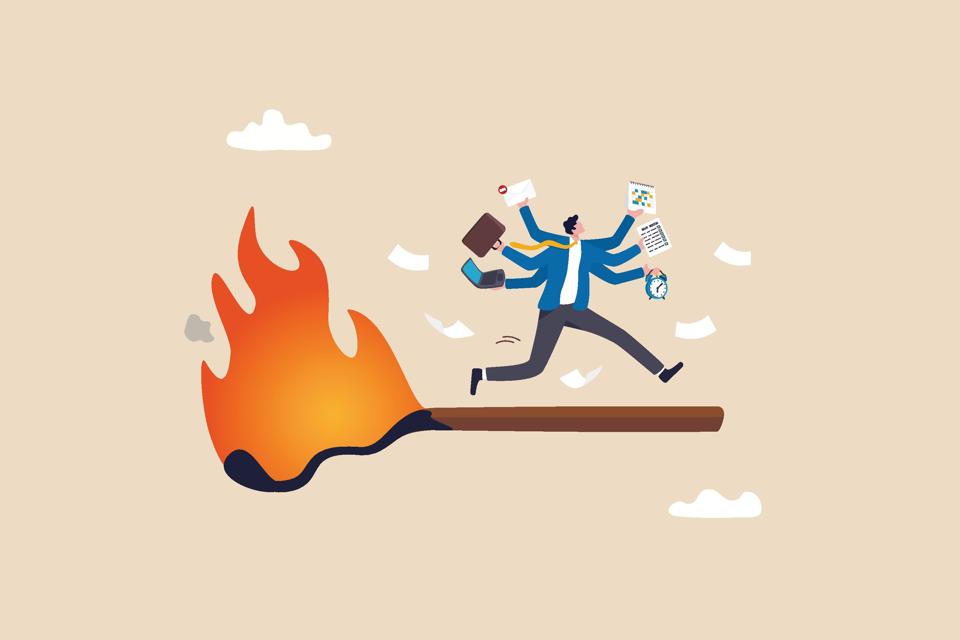
Does your job make you feel as urgent as the man depicted in the picture, sometimes faced with toxic productivity, panic or burnout, overworked and multitasking to finish within an unrealistic timeline?
getty
Friday October 10th was World Mental Health Day, and the American workforce is more anxious than ever, as the world becomes increasingly unsafe. With that in mind, every employee should have a “work care plan” to protect themselves from anxiety, burnout and stress-related illnesses. The incidences of job stress and burnout have jumped to an all-time high–66% in 2025 and are likely to remain elevated towards the end of the year. And experts are calling for mental health must-haves as we move into the New Year.
Mental Health Must-Haves
A data analysis from ComPsych—based on a representative sample of more than 300,000 U.S. cases—found that anxiety is now the number one presenting issue among American workers, topping depression, stress, partner/relationship issues, family issues and addiction and grief among other topics people sought help for.
Certain workplace must-haves are legally required to protect workers from potentially physical dangers on the job. Hazmat suits for toxic waste, face masks for Covid and other contagious diseases, hard hats for forestry and construction workers, safety glasses for welders. But few protections are in place for employee mental health. Think about toxic work cultures, required overtime, job burnout, layoff anxiety, unreasonable deadlines, job demands, restricted PTO, brutal work schedules. I could go on, but you get the point.
According to Monster’s 2025 Mental Health in the Workplace report, four in five U.S. workers say their job negatively impacts their mental health, a sharp increase from 67% in 2024. The report of more than 1,100 professionals underscores how toxic cultures, unsupportive managers and rising workloads are worsening mental health on the job.
- 80% of workers say they work in a toxic environment, up from 67% last year.
- 57% would rather quit than endure a toxic workplace.
- Top causes of poor mental health include toxic work culture (59%), a bad manager (54%) and lack of growth opportunities (47%).
- 51% believe their well-being would improve if toxic employees were removed.
10 Mental Health Must-Haves To Protect Yourself
The American workforce cannot always depend on organizations to offer flexibility, work-life balance or shield them from trends like the 9-9-6 work schedule, quiet layoffs, even toxic work environments. It’s up to employees to create a work care plan for what they need for protection when they work in a toxic environment.
If you toil in a toxic work culture, it’s important to weigh your options and find a workplace that prides itself on employee-centered empathy and care. You’re the captain of your ship—not a passenger. You’re in control of your mental health, not your employer. Evaluate your job and life and decide for yourself what reasonable steps you can take to mitigate your anxiety and amp up your work health.
The key is to create a work care plan that offsets collective trauma so you can reset your brain and keep it healthy. Here are 10 science-backed findings to help you create your own personalized work health plan, mitigate chronic anxiety and burnout and thrive at work:
- Meditation limits cortisol levels by 25%, according to research, and it reduces mind wandering, free-floating anxiety and mistakes, keeping you on task at work.
- Anxiety prevention foods promote mindful productivity and work health. Aim for protein, Omega-3 fatty acids, eggs, pumpkin seeds, B vitamins and Vitamin D, dark chocolate, turmeric, chamomile, yogurt, green tea and Brazil nuts.
- Regular exercise, such as the Japanese brisk walking method, re-calibrates a fatigued brain and reduces your risk of developing anxiety by almost 60%.
- Positive self-talk can stop catastrophic mind chatter that causes anxiety and keep you calm in stressful situations.
- Sleep deprivation leads to anxiety, and ample sleep is restorative for calming your mind and contributing to your work health.
- Microbreaks—short breaks of five minutes—throughout the workday mitigate fatigue, reduce anxiety and keep your brain rested and clear.
- Mindful abdominal breathing keeps your mind sharp and focused in the present moment when anxiety tries to steal your breath away.
- An optimistic outlook prevents anxiety from ruling your mind and gives you better memory at work. Plus, looking for the opportunity in the problem helps you scale the career ladder faster and farther than pessimism, according to research.
- Brain scans of people who spend time outdoors show their prefrontal cortex has more gray matter plus a stronger ability to think clearly and self-regulate stress and anxiety.
- Social engagement mitigates cognitive decline, enhances gray matter in the brain and helps reduce anxiety. So it’s important to avoid working in isolation and maintain social connections with coworkers to keep your mind active and healthy.
4 Mental Health Must-Haves For Employers
While employees share personal responsibility for their work health, organizations also are obligated to create a safe and stress-free work culture to support long-term employee mental and physical viability. Monster career expert Vicki Salemi shared with me four steps companies can take to mitigate burnout and advocate for workplace mental health.
1. Remove toxic employees.
According to Monster’s 2025 Mental Health Workplace Report, 51% of workers believe their well-being would improve if toxic employees were removed. Salemi calls this insightful and compelling, acknowledging that toxic workers are bad for the organization, morale, productivity, company culture and reputation, their boss and colleagues.
“They may often start with a performance improvement plan to discuss the performance with the troublesome worker and document specific behaviors and performances they want to alter, along with a timeline and checklist such as 90-days,” she proposes.
2. Address toxic managers.
Salemi acknowledges that toxicity can also stem from leadership and that companies should address toxicity that emerges from management at all levels. “ She cites the Monster study in which 54% of respondents say a top cause of their poor mental health is a bad manager. She also points out that 59% of workers say a toxic culture is the top cause of poor mental health at work, turnover, lower morale, satisfaction, productivity and company reputation.
She recommends that employers put “bad actors” on a performance improvement plan if they’re staying in the role, training them, demoting them or terminating them, depending on the situation.
3. Provide growth opportunities.
Salemi recognizes the importance of providing clear paths for workers to grow their career trajectory. According to 47% of the respondents in the Monster report, the lack of providing growth opportunities is a top cause of poor mental health.
Employers can map out with direct reports where they see their career headed with opportunities, skills and experiences they need to possess to get there. Providing metrics allows workers to see quantifiable goals they need to meet. If the company intranet site has information readily available with job descriptions for the variety of roles and pay ranges, it’s transparent to workers if they have questions.
4. Expand benefits.
When a company supports its employees such as taking time off for therapy, offering generous PTO and mental health specific policies, workers feel seen, heard and most importantly—valued, according to Salemi.
“Knowing that 63% of workers say they would prioritize mental wellness over having a “brag-worthy” job shows employers the priority to place on their mental health,” she states. “Some policies may take longer to approve and have financial buy-ins, but while they’re evaluating current policies, companies can start in small increments that won’t go over budget.”
Salemi insists that a healthy environment enables workers to speak up without fear, to have access to their boss and upper management and ultimately work in an environment where mental health is supported. When companies make mental health must-haves a priority for all employees, it’s a win-win for everyone, she concludes.
link
More Stories
Mental health in the workplace at Sioux Center chamber | Sioux Center News
Are In-House Therapists at Work a Good Idea? Diving Into Mental Health Musings
10 mental health facts every employer needs to know in 2026