




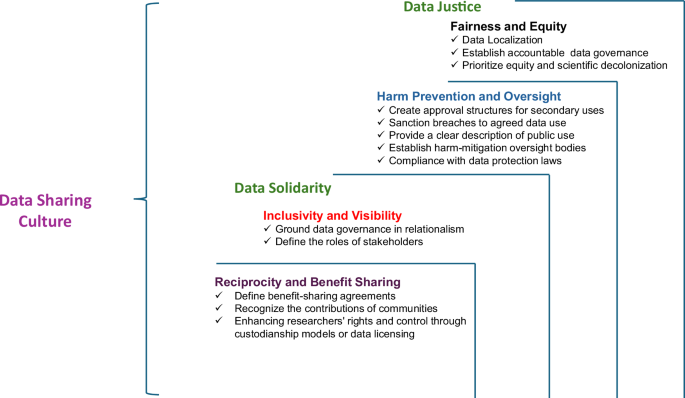
Translating the principles of fairness, inclusivity, harm prevention, and reciprocity into practice requires more than ethical aspirations. It demands institutional action, policy and legal frameworks, technical mechanisms for data sharing, and investment in data governance infrastructure that centres African autonomy and public value. Drawing from our experiences, we propose five operational strategies to help embed an ethical data culture into African health research systems.
Promoting data sovereignty and accountability
Research data is the lifeblood of scientific progress, central to publications, career advancement, funding acquisition, and academic visibility. In African health research contexts, the understandable hesitation amongst scientists and biotech or health innovation firms to share data is informed not only by professional considerations but also by long-standing experiences of extractive research practices, where African-generated data has been used without appropriate attribution, oversight, or benefit-sharing. Despite this, African researchers have consistently shown a willingness to share data, provided that ethical safeguards and accountable governance mechanisms are in place to prevent misuse, ensure fairness, and return benefits to contributing communities16.
To address these legitimate concerns around extractive health research practices, data science initiatives in Africa must transition from trust-based models that rely solely on goodwill to systems rooted in accountability, transparency, scientific freedom, and equity. One promising pathway is the development and adoption of Controlled Access Data Environments (CADEs), which are secure digital platforms that enable researchers to analyse datasets collaboratively without requiring data to leave their country or institution of origin. CADEs can help ensure compliance to legislations that emphasise data sovereignty. It also empowers researchers to retain custodianship over data while engaging in global collaborations on terms that are beneficial to all.
The CADE model is not theoretical; it is feasible if there is a will amongst all stakeholders. The H3Africa initiative, for example, is implementing a semi-controlled access model through its Data and Biospecimen Access Committee17. This body oversees the ethical use of genomic and health data by evaluating requests based on relevance, collaborative equity, and alignment with African health priorities. Although not a CADE in the technical sense, it mimics its core principles of ensuring that data remains within the control and oversight of African institutions. Furthermore, the DS-I Africa eLwazi project is designing next-generation data infrastructures and computing environments that would allow researchers to discover, access, and analyse data across multiple storage locations and to visualise the results without downloading the data.
From paternalistic to community-centred data governance
An ethical data culture requires that community agency is not a one-time checkbox, but a sustained and responsive process. To this end, integrating dynamic consent mechanisms could help ensure that data subjects have a voice and retain control over how their data is used throughout the research lifecycle. This could be effectuated by leveraging widely accessible digital technologies such as SMS and mobile apps, to enable data subjects to update their consent preferences over time, as their concerns and expectations evolve. However, digital tools alone will be insufficient in the African contexts due to the uneven access to technology as well as digital literacy. Therefore, dynamic consent must be complemented with offline channels such as printed newsletters, radio programming, or community meetings to ensure wider reach. For this to be possible, public engagement should be funded as a central component of data science initiatives, and not relegated to outreach or auxiliary roles. Embedding these relational practices in data science initiatives18 would strengthen respect for communities, accountability, and shared decision making, all of which are important to sustaining the core pillars of an ethical data culture.
Reciprocity: benefit-sharing, commercialisation and licencing
Too often, African research participants and their communities remain disconnected from the innovations their data drives, whether these are commercial products, clinical interventions, or academic outputs. This could eventually undermine public trust in science. A central pillar of an ethical data culture is reciprocity, which is the principle that communities that contribute data must share in the benefits their data enables. This principle can be operationalised through formal benefit-sharing agreements and legally enforceable mechanisms that ensure research translates into health, social, and economic value for scientists and communities that provided data. To achieve this, benefit-sharing must become a component of funded projects, ethics review processes, and institutional policies. Benefit-sharing agreements can include access to interventions or diagnostics developed from the research; capacity-building investments, such as training, data infrastructure, and institutional strengthening; co-authorship and recognition in academic publications and patent applications; and revenue-sharing mechanisms where commercialisation is pursued.
Another pathway for operationalising a culture of reciprocity is through ethical commercialisation and data licensing. When guided by equitable principles, it can empower African institutions to transition from the role of data suppliers to full participants in the health innovation economy19. African research institutions must establish data licensing frameworks that govern how data is reused, by whom, and under what conditions. These licences should define permissible uses, mandate appropriate attribution, and include enforceable obligations for benefit-sharing or reinvestment into health systems that contribute data. This could be done by engaging legal and innovation offices within universities and research institutes to ensure data use aligns with institutional and public interests. In parallel, strong intellectual property protections are necessary to ensure that African researchers are not merely data providers, but also co-creators of innovation, with legal rights to patent, license, and commercialise outputs derived from their data. Furthermore, there is a need to develop data custodianship models, rather than narrow conceptions of data ownership, to manage data stewardship in ways that the interests of researchers, institutions, funders, and data are appropriately balanced.
link
More Stories
Research Fellow in Health Services job with FLINDERS UNIVERSITY
Sunnybrook Health Sciences Centre Receives $10 Million Gift To Expand OCD Research, Education And Treatment
On Research: The importance of flexibility during times of crisis