




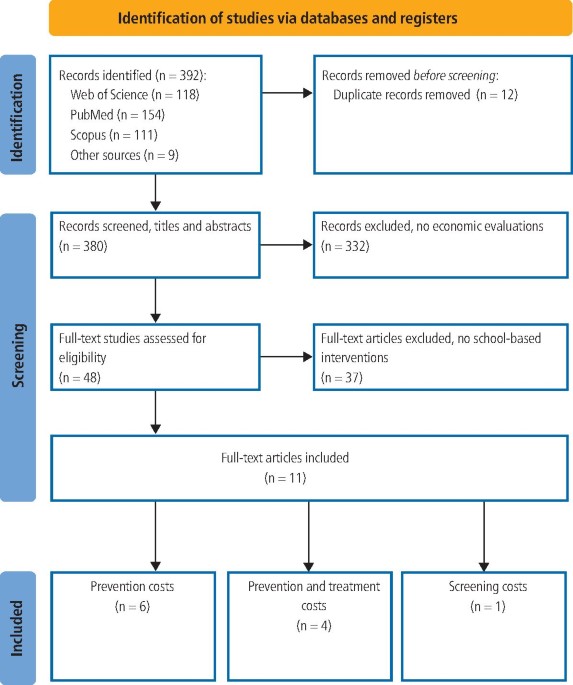
The literature search identified a total of 392 records. After removing duplicates, 380 articles were screened by title and abstract. Of these, 48 full-text articles were assessed for eligibility as they reported some form of economic evaluation. A total of 11 studies met the inclusion criteria and were included in this review. These studies were grouped into three categories based on the intervention focus: prevention-only interventions, combined prevention and treatment interventions, and screening interventions (Fig. 1).
Of the 11 included studies, seven were full EEs and four were cost analyses or cost-minimisation studies (Table 2). The majority of studies were conducted in high- or upper-middle-income countries, including the United Kingdom (UK), the United States, South Africa, Sweden, China, Australia, Germany, Thailand and Scotland. Most interventions focused on primary prevention strategies, particularly fluoride varnish and sealant application. A smaller number of studies included treatment costs or evaluated broader service delivery models. Only one study addressed the cost-effectiveness of a caries screening tool in a school setting. No formal critical appraisal of the included sources of evidence was conducted, as this scoping review aimed to map the available evidence rather than assess the methodological quality of individual studies, consistent with established scoping review methodology guidelines.
The CHEERS checklist14 has been used in this review as a descriptive approach, aligning with the scoping review’s goal of mapping the evidence rather than evaluating it. Therefore, the reporting quality and completeness of EEs in dental healthcare have been assessed. The purpose of the checklist is to ensure that EEs are reported transparently and consistently. CHEERS 2022 includes 28 items grouped into categories like: title and abstract, introduction, methods (e.g., target population, comparators, perspective, time horizon, discount rate, outcome), results (e.g., cost, outcomes, uncertainty), discussion, others (e.g., funding, conflicts of interest). A study that addresses all or most items clearly and thoroughly is considered to have high reporting quality. Missing or vague information on several checklist items might indicate low quality reporting, which could reduce confidence in the study’s conclusions. The overall mean percentage of applicable CHEERS checklist criteria met by the studies in this review is 75%. The median score is calculated at 78%. CHEERS criteria were met in a range of 59–93%. Table 3 shows how the included studies met the CHEERS criteria. A common methodological deficiency surrounded the issue of the approach to engagement with patients and others affected by the study. The poorest performing criterion in the CHEERS checklist is related to characterising generalisability and heterogeneity of power. To illustrate the reporting gaps more clearly, Figure 2 displays the CHEERS items that were not reported in the included studies.

CHEERS items not reported
Prevention-only economic evaluations
Six studies focused solely on school-based caries prevention interventions. Of these, four were full EEs (primarily CEA or CUA) while two were cost analyses without effectiveness outcomes.
Several studies modelled preventive interventions over extended periods, often beginning at school entry and following children through to adolescence. These interventions typically included fluoride varnish applications, fissure sealants, and atraumatic restorative treatment (ART), individually or in combination. Outcomes were frequently measured using DMFT/dmft,15,16 with some studies also incorporating preference-based outcomes such as QALYs17 or disability-adjusted life years (DALYs).18
In general, fluoride-based interventions and sealants were found to be effective at reducing caries incidence. When compared to ‘no intervention’ scenarios, these approaches were often cost-effective and, in some cases, cost-saving over the long-term.15,16 However, results varied by context. For example, a trial conducted in UK nursery schools reported a low probability (11.3%) of fluoride varnish being cost-effective at the standard £20,000/QALY threshold, highlighting how cost-effectiveness can depend on setting, delivery model, and baseline risk.17 While sealants were generally more effective at preventing caries than fluoride varnish, their higher delivery costs, particularly due to staff time, meant that fluoride varnish often emerged as the more cost-effective option in resource-constrained settings.16
Some evaluations adopted a broader societal or health system perspective, incorporating indirect costs19 or modelling wider health outcomes such as DALYs.16 These models provided useful insights into long-term value and impact. In contrast, cost analyses conducted without direct effectiveness measures focused on estimating the financial requirements of programme implementation. These studies provided useful insight into resource use, suggesting that preventive interventions in early years settings could be delivered at relatively low per-child costs,19 especially when integrated into existing school health infrastructure. Cost comparisons between ART and fissure sealants, for example, highlighted potential savings in field-based programmes.20
Combined prevention and treatment evaluations
Four studies evaluated school-based programmes that combined caries prevention with treatment, providing insight into models that offer both diagnostic and therapeutic services.
Across these studies, the inclusion of both preventive and restorative components aimed to reduce the need for invasive treatment by promoting early intervention. The programmes often integrated fluoride-based approaches with routine screenings and follow-up treatment when needed. EEs in this category adopted both health system and societal perspectives and varied in terms of outcome measures, time horizons, and cost components included. One modelled analysis assessed the application of fluoride varnish every three months alongside supervised toothbrushing. Although the intervention resulted in a reduction in cavitated lesions, the overall cost increased due to the intensity and frequency of application, and there was insufficient cost offset from avoided treatment needs. As such, the intervention was not considered cost-effective in this context.21 Conversely, school-wide fluoridation programmes, such as the provision of fluoridated milk, demonstrated more favourable outcomes. A Thai study reported a 34% reduction in decayed, missing and filled surfaces and concluded that the programme was both cost-effective and associated with long-term societal cost savings.22 These findings suggest that embedding milk fluoride within routinely school-based resources may be a more scalable and sustainable option.
Two further studies examined cost patterns associated with school-based mobile dental programmes that delivered both preventive and restorative services. In Scotland, the national nursery toothbrushing programme was associated with a significant reduction in treatment costs over time, declining from £8.8 million to £4.0 million across a nine-year period.23 In Australia, a mobile school-based service showed a shift in resource allocation over four years, with increased use of diagnostic and preventive services and a corresponding decline in restorative interventions.24 These trends align with the principles of minimally invasive dentistry and suggest a potential for long-term savings when early prevention is prioritised within integrated care models.
Screening interventions
Only one study in the review evaluated the economic impact of a school-based dental screening intervention. This model-based analysis compared near-infrared light transillumination (NILT) with traditional visual-tactile methods for detecting caries in 12-year-old children. The evaluation focused on both diagnostic performance and downstream clinical outcomes, with effectiveness measured in terms of tooth retention time and the need for further treatment. The results indicated that NILT not only improved early detection accuracy but also extended the average lifespan of affected teeth. From an economic perspective, it was considered both minimally more effective and cost-saving compared to conventional screening methods.25 The study has several limitations. The novel non-invasive diagnostic method does not align with standard clinical caries detection protocols. While the intervention demonstrated potential for identifying untreated dental needs and reducing care gaps in the study setting, the accuracy of the diagnostic approach has not been fully validated, raising concerns about its clinical reliability. Moreover, the applicability of this model to other healthcare contexts, such as the UK – where school dental screening programmes have been discontinued – may be limited due to differences in public health infrastructure and policy.
link
More Stories
Dental Services Market: Cosmetic Dentistry Demand, Smile Makeovers & Market Forecast
In HelloNation, Dental Expert Dr. Mark Luvisotto of Windsor, ON, Explains Services Covered Under the Canadian Dental Care Plan
Press Release: Durbin Announces $3.5 Million Federal Funding for Parkland College Dental Education Program