




You have full access to this article via your institution.
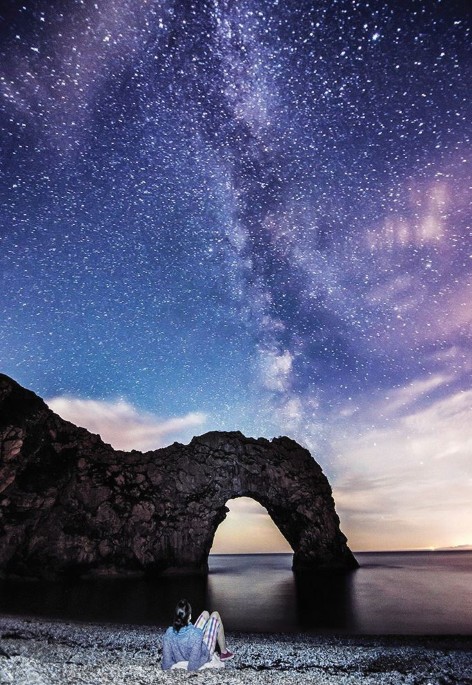
Ever since we first looked up to the stars above we have dreamed of slipping the surly bonds of Earth to touch the face of the heavens, yearning for the freedom to explore the undiscovered and unravel the unknown. Our nights are lit with the glow of our moon and neighbouring planets, with the history of galaxies light years away, and with the birth of new worlds in the nuclear nurseries of turbulent nebulae. The mysterious eternity beyond the observable universe is expanding faster than light, denying us the possibility to ever see or know it. We have redefined our concept of reality from three dimensions and linear time to four dimensions with time itself as a variable.

And you are reading this attached to a mote of dust hurtling through those dimensions, around the sun at 67,000 mph and within its system around the Milky Way galaxy at 514,000 mph, round trips that respectively take 1 year and 225 million years. The Earth’s mass has an imposition on the fabric of space-time, something we call gravity, keeping us firmly tethered to her surface like a mother clutching her children. As terrestrial organisms we have evolved to exist upon her density and within her atmosphere. And our determination to unshackle ourselves from her embrace has revealed the inevitable consequences for human systemic and dental health.
In the latter half of the 20th century humans developed the propulsion technology that enabled them to escape Earth’s gravity and achieve orbital velocity. Today space exploration is planning for prolonged manned missions to both the moon and Mars and even beyond, to places that were once only located inside our imagination.
However, as we aspire to extend our interstellar footprint our biology becomes the unfortunate victim of our ambitions. Saliva production, microbial composition, bone density and muscle mass are all affected. Our heroes of space travel have reported issues as diverse as caries and periodontal disease, oromaxillofacial fractures, sensory abnormalities in the teeth and oral mucosa, masticatory muscle atrophy and oral cancer. Increased exposure to gamma and cosmic background radiation has impacted retinal and dermal health, and despite regimented exercise routines the revolving inhabitants of the International Space Station have experienced joint and bone disorders upon their return to Earth.
Perhaps somewhat ironically, even though these physiological effects are akin to accelerated ageing, the astronauts above us are in fact ageing slower than the rest of us mere mortals on the planet’s surface. But don’t rush to get fitted for a spacesuit. The difference is actually negligible and is due to the effects of time dilation. Despite the ever-so-slightly weaker gravitational field away from the Earth allowing time to speed up, their increased velocity through space produces a net slowing down. Thanks to these principles of general and special relativity, in the course of your entire lifetime your head will age imperceptibly faster than your feet. Unless, like me, you spend much of your time in a handstand, which might explain my infantile brain and wrinkled soles.
Traditional dental care and oral hygiene is more difficult in a microgravity environment, which can induce symptoms not easily treatable in the cold isolation of space.
The microgravity experienced in space is often erroneously referred to as zero gravity, a hypothetical condition that, in our current understanding, cannot exist because gravity is never truly absent from any known environment. Without the established influence of Earth’s gravity on our bodies the integrity of all of our anatomical structures and physiological systems is subject to deterioration, especially rapid mineral and calcium loss. This can diminish jawbone solidity, weaken interdental bone and even precipitate tooth mobility. Traditional dental care and oral hygiene is also more difficult in a microgravity environment, which can induce symptoms not easily treatable in the cold isolation of space.
Saliva flow rate is reduced in microgravity due to changes in the body’s fluid distribution, and compounded by increased bone resorption this heightens the risk of sialolithiasis. The greater virulence of oral bacteria and a compromised immune response can result in delayed wound healing and more dental disease, while pre-existing dental restorations, such as fillings or crowns, may fail when exposed to high-altitude environments, a phenomenon called odontocrexis. This is typically due to the unintentional expansion of gases trapped beneath the restorations. The increased pressure may forcefully dislodge the restoration from the tooth, causing what is colloquially known as a ‘tooth explosion’.
The current management for dental and systemic wellbeing in space is mainly nutrition and exercise, the same essentials that keep us healthy on Earth. That, and ensuring all astronauts have excellent dental health before launch. But ongoing research into all these afflictions is leading to developments that could combat dental disease both inside and outside our atmosphere.
Now, let’s be honest, most of us are probably not going to become astronauts. Or treat many. I did receive a curious offer to be launched into space but I am minded to believe they intended that to be a one-way trip.
And while many argue that we should endeavour to solve the problems we have on Earth before exploring the rest of the universe, the collective future of our species will involve more protracted bouts of exploration and even tourism in space. If future generations of dentists wish to remain contemporary they may need to curtail their cosmetic caseload to embrace this manifest destiny. There may even come a time when the syllabus at dental schools will have a component of space dentistry or at least offer it as a postgraduate course.
At the moment this may all seem like a distant fantasy. But the calcium in your teeth was forged in a star exploding in a supernova. Indeed, all of the atoms in your body originated in these cosmic nuclear fusion reactors and were expelled into space before eventually finding their way to your construction. The singer Joni Mitchell romantically labelled us stardust. The more prosaic among you (i.e., dentists) may call us nuclear waste. But there is no denying both our galactic origins and our inescapable spacefaring destiny.
The next time you look up at the stars after a hard day of harvesting pulps just remember that there is nothing between your eyeball and the rest of the universe except a layer of invisible gases. The future challenges for your profession won’t simply be limited to the surface of this beautiful blue marble we call home, but will expand into the boundless frontier out there amongst the stars…
Useful resources
- 1.
Samathu J H A, Mani R, Venkatesh V, Vaishnavi A, Sacrapani L. Smile beyond the stars: a narrative review exploring the challenges for dentistry in space. Cureus 2024; DOI: 10.7759/cureus.66591.
- 2.
Chhabrani A, Avinash B S, Bharadwaj R S, Kale R, Kathuria A. Microgravity’s dental dilemma: Navigating oral health challenges in space, from effect on bone to therapeutic frontiers – A review. Acta Astronautica 2024; 219: 363–375.
- 3.
Bakri A, Ismail A, Mansour A et al. Microgravity exacerbates periodontitis in vivo. J Periodontal Res 2025; DOI: 10.1111/jre.70000.
link
More Stories
Dental Services Market: Cosmetic Dentistry Demand, Smile Makeovers & Market Forecast
In HelloNation, Dental Expert Dr. Mark Luvisotto of Windsor, ON, Explains Services Covered Under the Canadian Dental Care Plan
Press Release: Durbin Announces $3.5 Million Federal Funding for Parkland College Dental Education Program