




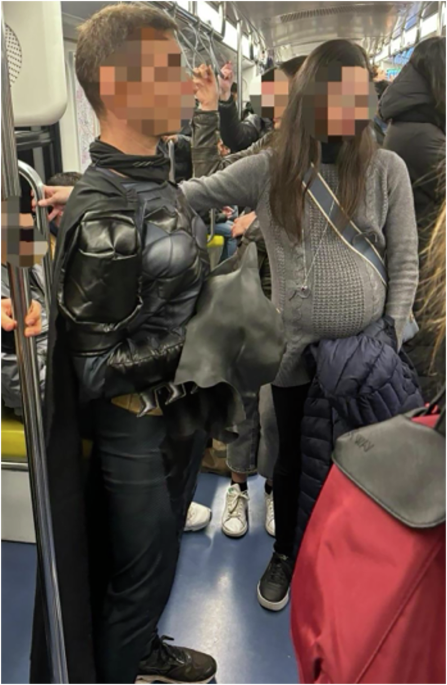
The study provides evidence that unexpected events, such as the presence of a person dressed as Batman, can significantly increase prosocial behavior in real-world settings. Specifically, we found that when Batman was present, passengers were more likely to offer their seat to a seemingly pregnant woman compared to the control condition. Such “Batman effect” supports the hypothesis that disruptions to routine can heighten awareness of one’s surroundings and enhance sensitivity to the needs of others, ultimately promoting prosocial actions.
Our findings resemble prior research linking present-moment awareness to increased prosociality; mindfulness may create a context in which individuals become more attuned to social cues. However, this remains a tentative interpretation: evidence on mindfulness-induced prosociality is still emerging—one meta-analysis finds only moderate effects10, and trait mindfulness seems most impactful when coupled with strong moral identity11. Unlike traditional mindfulness interventions that require active engagement, this study highlights how situational disruptions alone may be sufficient to produce similar effects. This suggests a potential mechanism by which novelty and unpredictability foster prosocial behavior, reinforcing theories that link attentional shifts to increased social responsiveness. At the same time, alternative explanations should be considered. For instance, the superhero figure may have increased the salience of cultural values, gender roles, and chivalrous helping norms, in line with research on superhero-related priming. Therefore, a more parsimonious explanation is that the Batman figure served as a prosocial prime. Yet, this explanation, too, should be approached with caution: close replications of social priming effects largely failed to reproduce original findings12. More broadly, it is much easier to verify that participants were breaking routine scripts than to establish that they were in a state of mindfulness. This interpretation is consistent with research on the “pique technique,” where atypical or unexpected stimuli disrupt automatic responses and increase compliance13. More studies are warranted to better understand the mechanisms underlying these effects and to disentangle whether they are driven primarily by attentional shifts, priming, or other contextual processes.
Interestingly, while the data suggest that this perturbation may have a strong effect, a notable percentage of individuals were not consciously aware of the reason behind it. Given that attention is socially influenced (e.g., the phenomenon where people instinctively look toward the same point of interest as those around them), we can hypothesize that the pattern of awareness triggered by a disruption in routine may be socially transmitted, extending beyond its original cause. This may also help account for the subset of participants who reported not noticing Batman but nevertheless offered their seat. A speculative interpretation is that the disruptive effect can operate at an interpersonal level: shifts in attention or prosocial cues triggered in some individuals may spread socially within the group, influencing behavior even among those not directly aware of the initial disruption, consistently with research on the social contagion and interpersonal synchrony of prosocial and emotional behaviors14.
These findings contribute to discussions on how public spaces and social interventions can be designed to encourage kindness and cooperation. If unexpected yet non-threatening events can increase mindfulness and prosocial behavior, urban planners, policymakers, and psychologists may consider ways to integrate “positive disruptions” into daily life. This could range from artistic or theatrical interventions in public spaces to strategic messaging campaigns designed to momentarily break routine and engage individuals more deeply with their environment and community.
Despite the promising findings, some limitations should be acknowledged. First, while the study was conducted in an ecologically valid setting, it was limited to a specific public transportation system, and cultural or contextual factors may influence the generalizability of the results. Additionally, the experimental manipulation involved positive symbolism (Batman is a superhero), which may have increased the salience of positive values, thereby prompting prosocial behavior, as suggested by past research investigating the effects of superhero-related priming15,16. It remains unclear, however, whether the observed effect is unique to Batman or would also emerge with other unexpected figures. Future research should therefore test a range of characters or disruptions, varying in both emotional valence and symbolic meaning, to clarify the boundary conditions of this effect. Future research could explore whether different types of unexpected events, varying in emotional valence, produce similar effects. Controlled laboratory experiments, where these dimensions can be independently manipulated, will be needed to address this issue. A further limitation concerns the demographic data: sex and age were estimated by observers, which introduces the possibility of error. These results should therefore be considered descriptive rather than definitive. Finally, while we measured an overt behavioral outcome (seat offering), future studies could examine whether these effects extend to other forms of prosociality, such as helping behaviors in different contexts or long-term shifts in social awareness.
In conclusion, this study suggests that unexpected events can increase prosocial behavior by momentarily disrupting automatic attention patterns and fostering situational awareness. These findings open new avenues for understanding the environmental and cognitive mechanisms underlying prosociality, and suggest potential applications for promoting kindness and cooperation in everyday settings—extending the “Batman effect” to non-superheroes as well.
link
More Stories
Research Fellow in Health Services job with FLINDERS UNIVERSITY
Sunnybrook Health Sciences Centre Receives $10 Million Gift To Expand OCD Research, Education And Treatment
On Research: The importance of flexibility during times of crisis